
As the steel industry enters an era of low profit margins, producing high-value-added clean steel has become a strategic necessity for steel enterprises. Clean steel technology research and production process control have consequently become critical priorities for steel manufacturers worldwide.
The key to producing clean steel lies in reducing impurities, and the key to controlling impurities lies in accurate and rapid determination of these impurities followed by optimization of the corresponding steelmaking processes. Analyzing non-metallic inclusions in steel is a complex task requiring both an understanding of the types of inclusions present and precise quantification of their size, quantity, and distribution.
The Evolution of Inclusion Analysis Technology
Over nearly three decades, steel inclusion analysis has undergone three major technological iterations:
First Generation — Manual Optical Microscopy: Operators manually examined samples under optical microscopes, comparing observed inclusions against standard reference charts (e.g., ASTM E45, GB/T 10561). This approach was labor-intensive, subjective, and limited in statistical robustness.
Second Generation — Automated Optical Image Analysis: Computer-controlled optical microscopes with image analysis software enabled automated scanning and classification based on grayscale contrast and morphology. While faster, this approach still suffered from fundamental limitations — optical contrast cannot reliably distinguish between different inclusion types with similar reflectivity, and no compositional information is available.
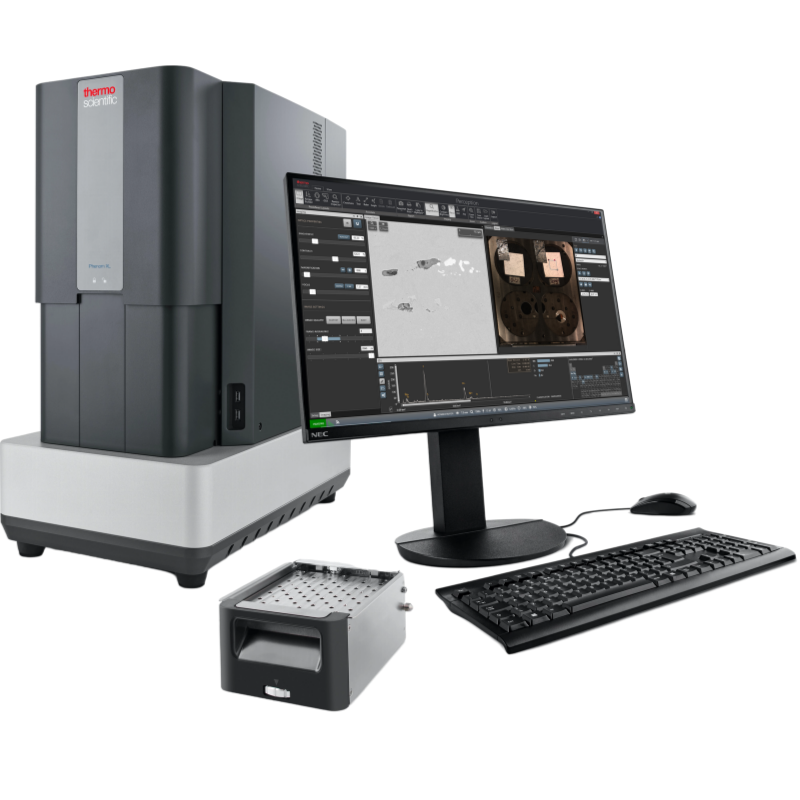
Third Generation — Automated SEM-EDS Analysis: The current state-of-the-art uses SEM with BSE imaging for high-contrast inclusion detection (independent of optical properties) combined with EDS for automatic elemental composition determination of each inclusion. The ParticleX Steel system represents this third-generation technology, featuring:
- Dynamic electron beam control with Complex Feature Analysis (CFA) algorithms
- Ultra-long CeB₆ crystal filament lifetime for extended unattended operation
- 7×24h unattended automated analysis capability
- Automatic classification per ASTM E2142-E45, GB/T 30384, and other international standards
- Comprehensive reporting including particle morphology, size distribution, and elemental composition data
This third-generation approach has transformed inclusion analysis from a bottleneck into a powerful quality assurance and process optimization tool, enabling steel producers to precisely control non-metallic inclusions and ensure stable production of high-quality clean steel.