
Introduction
As analyzed in Part 1, optical microscopy-based cleanliness analysis is prone to misclassification of metal and non-metal particles and cannot provide compositional information, making it impossible to identify specific contaminant types. Additionally, the limited resolution of optical microscopy leads to miscounts of small particles. In response to these practical needs, the fully automated contaminant detection solution ParticleX Battery was developed to perform morphological and quantitative analysis of contaminant particles, distinguish particle types (such as Fe, Cu, Zn, Ni, Cr, etc.), and output comprehensive cleanliness analysis reports.
The ParticleX Battery Solution
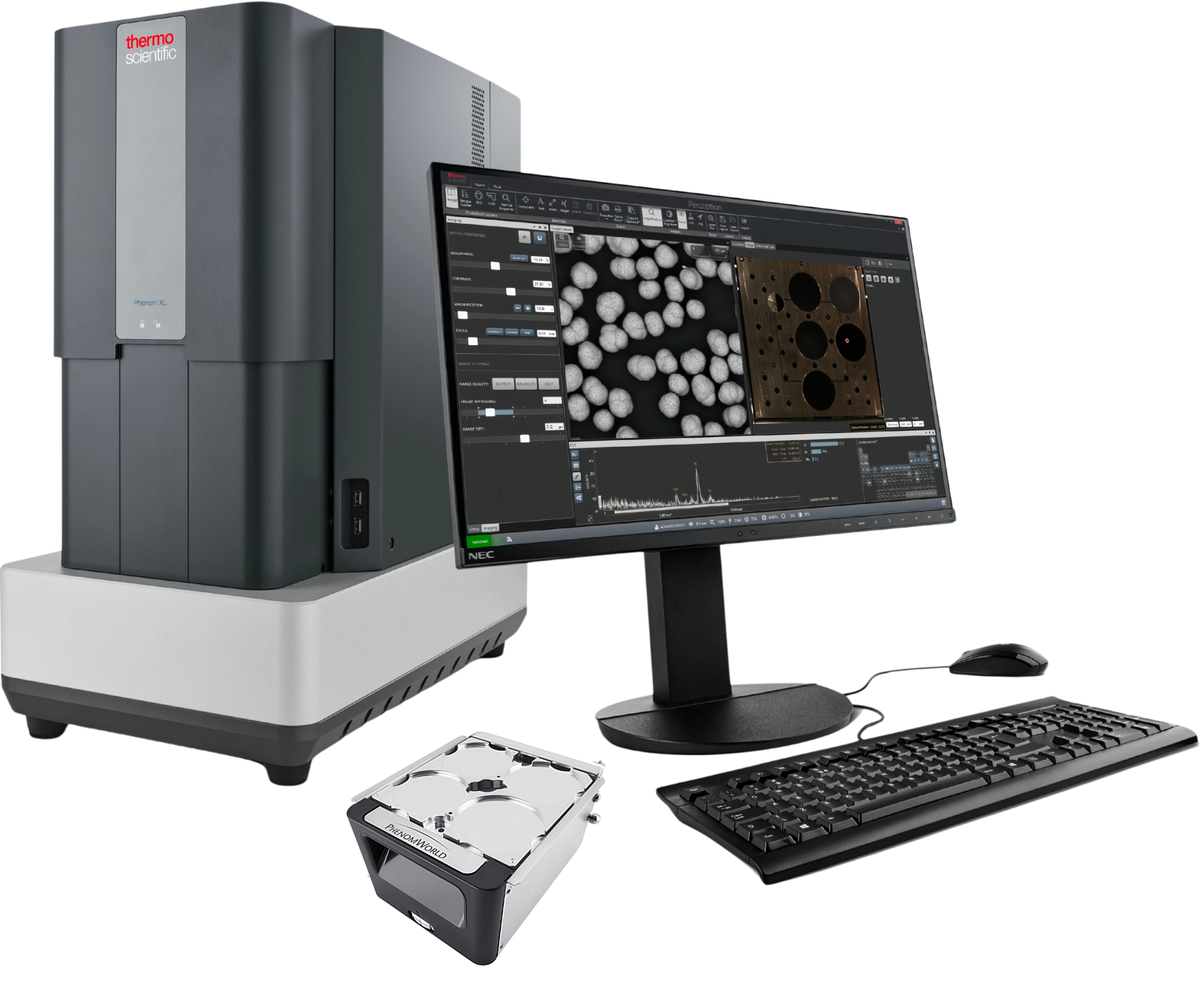
ParticleX Battery is a fully automated lithium battery cleanliness analysis system based on Scanning Electron Microscopy (SEM) combined with Energy Dispersive Spectroscopy (EDS). The system operates through an automated workflow:
1. Automated Particle Detection: The system scans the sample surface and automatically identifies all particles based on backscattered electron (BSE) contrast, with detection sensitivity down to sub-micron levels.
2. Morphological Analysis: For each detected particle, the system records size (length, width, area), shape parameters, and coordinates.
3. EDS Elemental Analysis: The EDS detector automatically analyzes the elemental composition of each particle, enabling clear distinction between metal particles (Fe, Cu, Zn, Ni, Cr, etc.) and non-metal particles (ceramics, oxides, organic residues).
4. Automated Classification: Based on compositional data, particles are automatically classified into categories such as iron-based, copper-based, zinc-based, ceramic, organic, etc.
5. Report Generation: The system generates comprehensive reports including particle size distribution, classification statistics, particle location maps, and individual particle analysis details.
Comparison: Optical Microscopy vs. SEM-EDS
Compared to optical microscopy, the SEM-EDS approach offers decisive advantages: (a) unambiguous identification of metal vs. non-metal particles through elemental analysis; (b) detection of smaller particles at higher resolution; (c) objective, automated analysis eliminating operator subjectivity; (d) compositional data providing clues for contamination source tracing; and (e) higher throughput enabling statistical significance in quality control.
Industry Adoption and Standardization
The ParticleX Battery system has become the industry standard for lithium battery cleanliness analysis, adopted by leading battery manufacturers worldwide. The automated SEM-EDS approach addresses the critical need for rapid, accurate, and comprehensive metal contaminant analysis in an industry where even trace levels of metal impurities can have catastrophic consequences for battery safety and performance.